Filling out graduate applications can feel daunting, which is probably why many of us keep procrastinating and telling ourselves, “I’ll start tomorrow.” Somehow, tomorrow keeps moving. The process becomes even harder when students do not have access to clear information about what to do, what to avoid, and what actually matters. This blog brings together the perspectives and experiences of multiple students who have navigated graduate applications. I also hope to write a blog from the perspective of the faculty and admissions committees.
Before we begin, I would like to thank Abdullah Ijaz, Aminah Ali Amjad, Angana Borah, Hamza Rafi, Hira Jamshed, Moaiz Abrar, Muhammad Taha, Mutahar Ali, Nida Tanveer, Taha Akbar, Taha Zakir, and Zoha Hayat Bhatti, listed alphabetically so nobody starts checking who came first. This blog would not have been possible without them generously sharing their experiences, advice, and lessons from the graduate application process.

Let’s begin with the generic advice, the things almost everyone agrees are important. Start early. Long before application season, talk to advisors, instructors, and graduate students about whether a master’s or Ph.D. better fits your goals and what experiences you should build beforehand. Once you decide to apply, begin preparing the actual applications with enough time to avoid rushing. Some people recommend starting applications in August, others September or October. I think mid to late September is usually fine. Applications are rarely the only thing happening in your life. You may also be taking courses, completing projects, handling family responsibilities, meeting friends, or simply having days when you do not feel like updating your résumé again.
Once you have a rough timeline in mind, the next step is to understand what you will actually need for an application. Most graduate applications ask for a statement of purpose, an academic CV, transcripts, and 2–3 letters of recommendation. International applicants also need a TOEFL or IELTS score. Some universities additionally ask for a one-page résumé, a personal statement, test scores such as the GRE, a degree certificate if you have already graduated, or responses to a few university-specific prompts. The list may look intimidating at first, but it becomes much more manageable once you take it one document at a time.
Before working on any one part of the application, read the requirements of every university carefully. The list above is only a general guide, and applications are not always identical. One university may ask for two letters of recommendation while another asks for three. Some may require the GRE, a personal statement, or responses to additional prompts, while others may not. Even the formatting and length requirements for the statement of purpose can differ. It helps to record all of this in a spreadsheet, including the deadline, required documents, number of recommendation letters, test requirements, application fee, and any word or page limits. It may feel slightly tedious, but it is much better than discovering an extra 500-word question on the day of the deadline.
Once you know which tests your universities require, try to complete the TOEFL or IELTS by September. This gives you enough time to take the test again if you are not happy with your score. And if the first attempt does not go well, that is completely okay. You can take it a second or even a third time. Do not beat yourself up over it. You are already balancing your final year of undergrad, graduate applications, and these tests on top of everything else. Also, check the score requirements of each university carefully. As for the GRE, many universities had stopped requiring it when I applied, and hopefully that is still the case, but do not assume. Check before spending time and money preparing for a test you may not need.
When it comes to preparation, please learn from my mistake and understand the exam format before test day. The first time I took the TOEFL, I had barely looked at the format. I basically discovered how the exam worked while I was already taking it. Not my best decision. I ended up taking the exam a second time. This time, I watched YouTube videos on each section and completed a few official practice tests under timed conditions. Since the TOEFL format has changed since I took it, I cannot give very specific advice on how to prepare today. GregMat was a useful resource during my time, though, but please do check whether their material has been updated for the current format. Whatever resources you use, make sure you understand the exam format before test day and can complete each section within the given time limit.

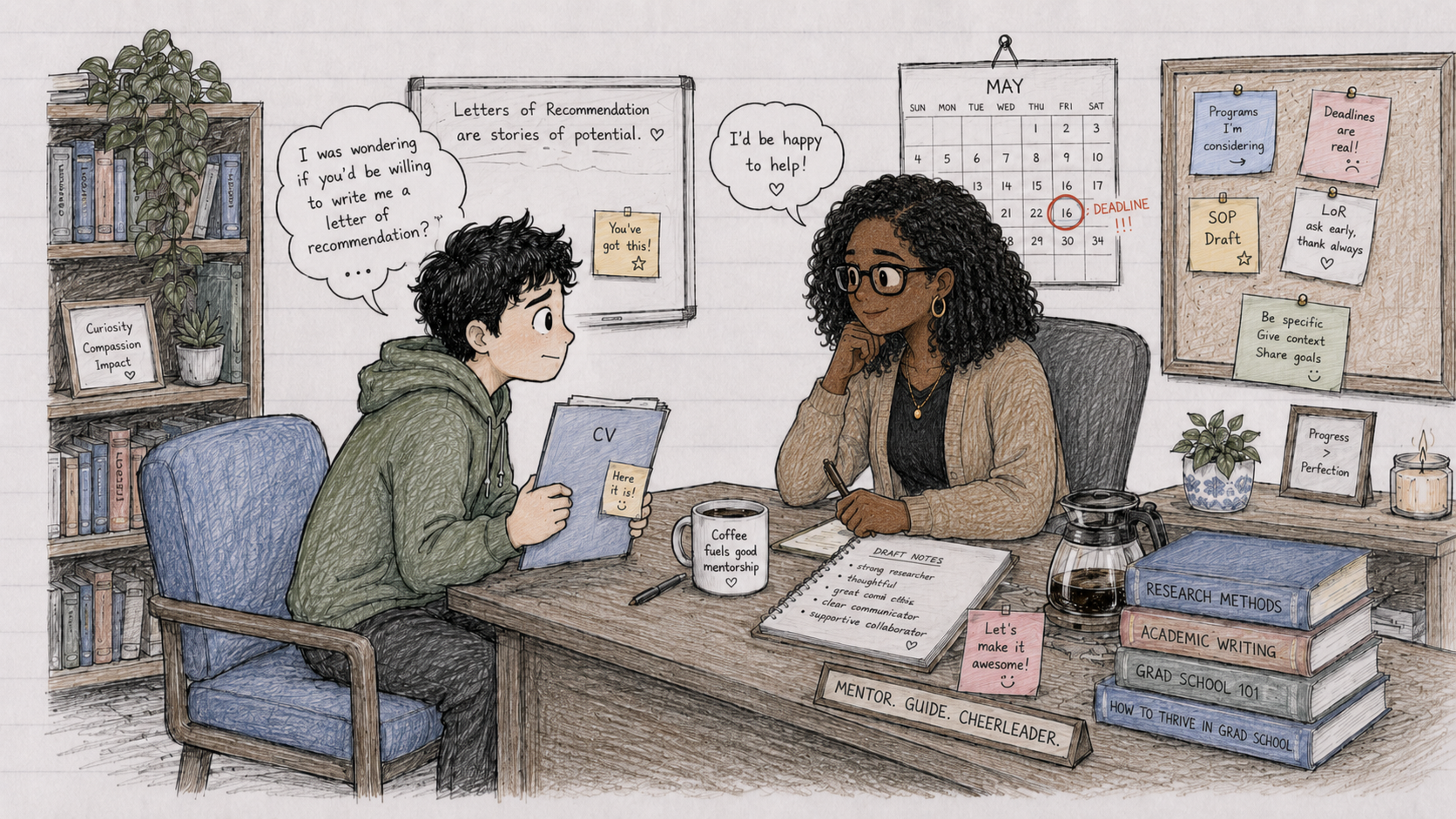
Once you decide that you are applying to graduate school, reach out to your professors about letters of recommendation as early as possible. Professors are usually writing letters for several students while also managing courses, research, meetings, and everything else on their schedules. Give them enough time to write a thoughtful letter rather than asking a week before the deadline and then checking your inbox every few minutes. You can also ask whether there is anything you can do to help them write a stronger letter, such as sharing your CV, statement of purpose, deadlines, and the programs you are applying to.
Also, remember that professors are human. They may not remember every detail of a project you worked on together, especially if some time has passed, so send them a short reminder of what you worked on, what your role was, and any outcomes you are proud of. And do not be too nervous about asking. Many students, including me, find this conversation stressful, but professors generally know that students will eventually apply for graduate school. The longer you postpone asking, the more stressful it becomes for everyone.
I prepared both a one-page résumé and a longer academic CV for my applications. The résumé gave a concise overview of my most relevant work, while the CV allowed me to include more detail about my research, projects, publications, teaching, and other academic experiences. An academic CV does not need to be limited to one page, but that also does not mean every project needs several long paragraphs. Keep the information easy to scan and include details that help the reader understand what you actually contributed. The appropriate length will depend on your experience, so ask your professors, seniors, and other students for feedback rather than treating one number as a strict rule.
For describing projects on my résumé, I found a simple three-point structure useful. The first point explains the problem or motivation behind the project, the second describes what I actually did, and the optional third highlights why the work mattered or what improved because of it. On my CV, I usually expanded the second part into a few more points when the project needed additional detail, although sometimes the motivation or results also deserved more space. I still tried to keep each point short and avoided adding more than four or five bullets for one project. This is not the only correct way to write about your work. It is simply the structure that helped me tell my story clearly, so read other approaches too and use the one that fits your experience best.
I applied to graduate school three times, for Fall 2023, Fall 2024, and Fall 2025, before I finally ended up where I wanted to be. Below, I have annotated the résumé I used for each cycle so you can see how it changed over time. Please do not laugh too much at the earlier versions, although the final one was far from perfect too. Even the CV that got me into graduate school was imperfect, and imperfect does not mean bad. A CV that feels perfect today may look imperfect later as we learn more. We learn as we grow, and I managed to age quite a lot over those three application cycles.
Once your résumé or CV gives you a clear view of your experiences, the next step is to turn those experiences into a story through the statement of purpose. Before you begin writing, take some time to reflect on why you want to attend graduate school and what you hope to gain from it. Your answer may change later, but having one will make your statement much clearer. The SOP gives you the space to explain your academic journey, research interests, and reasons for applying to a particular program, while showing how the different parts of your experience connect. A useful resource is the CS Statement of Purpose collection. Do not simply read these statements. Study them. Pay attention to how one paragraph transitions into the next, how the writers introduce their research experiences, and how they connect their past work to what they hope to do in graduate school. I think the opening paragraph deserves particular attention because it creates the reader’s first impression. You should also study how people end their statements.
At the same time, do not force your profile into someone else’s structure. Their statement works because it tells their story, not because it follows a universally perfect template. Think of these examples as maps showing possible routes, not forms where you replace someone else’s project names with your own. For formatting, I personally used Times New Roman, an 11-point font, single spacing, and a maximum of two pages. I do not particularly like Times New Roman, but it looked clean and professional, so I made peace with it for the application season. A third page may also be fine when it contains only references or links to your work, but always follow the university’s instructions when it specifies a word limit, page limit, font size, spacing, or particular questions.
You should also tailor the statement to each program. The main story may remain similar, but the final section should explain why you are applying to that university. You do not need to know your exact Ph.D. topic, but your statement should still present a coherent research direction rather than suggesting that you are willing to work on anything. When discussing each project, explain not only what you did, but also what it taught you and how it shaped the questions you now want to explore. Publications are helpful, but they are not the only evidence of research potential. How you handled setbacks, responded to feedback, learned new skills, and grew through difficult projects can be just as revealing. Then connect those interests to the professors, labs, or research directions at the program. Organization and clarity matter too, since the statement also shows how well you can communicate research ideas. Avoid excessive praise, unnecessary adjectives, and complicated language added only to sound impressive. Explain the fit clearly and let your work speak for itself.
My usual structure is an introductory paragraph followed by paragraphs about my major projects. I then include relevant teaching or industry experience when it adds to the story, before ending with the program fit and my future goals. I order projects by their strength, breaking ties by placing the one most closely aligned with the faculty first. Since I applied in three different cycles, I ended up with three versions of my statement of purpose. Below, I have annotated them so you can see how the structure, storytelling, and presentation of my work changed over time. To reiterate, even the version that got me into graduate school was imperfect, and imperfect does not mean bad. Something that feels perfect today may look different later as we learn more.
Some universities also ask for a personal statement. This is usually different from the statement of purpose, although not always, so read the prompt carefully. In general, the statement of purpose focuses more on your academic background, research experience, and future goals, while the personal statement gives you space to discuss the life experiences, challenges, values, or circumstances that have shaped you. The exact distinction varies from one university to another, so do not rely only on the title of the document. Read what the university is actually asking you to write.

Choosing where to apply can feel overwhelming, so looking at universities where your seniors were accepted can be a useful starting point. Still, do not let their choices limit your search. Explore programs based on your research interests, faculty fit, graduate outcomes, and your own profile, including your GPA, research experience, and project quality. For master’s programs, also examine the curriculum and check whether the courses you care about are actually offered. Attend information sessions or public office hours when available, since they can give you a clearer picture of the program and sometimes connect you with a better-matched faculty member. Build a balanced list of reach, target, and relatively safer programs, then ask seniors and recommendation-letter writers for feedback before making the final judgment yourself. Also consider whether you would be comfortable living there. A Ph.D. may keep you in the same place for five or six years, so the cost of living, weather, transportation, community, and quality of life matter too. Even your relatively safer choices should be places you would genuinely consider attending.
For Ph.D. applications, start by checking department pages and individual faculty websites. Read just a few recent papers to understand the broader questions a professor works on. You do not need to follow every technical detail; the goal is simply to decide whether their research direction genuinely interests you. Lab culture matters too, so when possible, speak with current or former students about the advisor’s mentoring style, expectations, collaboration practices, and general lab environment. Also consider faculty seniority and lab stage. Recently hired professors may be actively building their labs, but senior faculty can be an equally strong fit. My advisor is a full professor, so limiting your search to junior faculty could mean missing a good opportunity. Finally, the professors you mention should form a reasonably coherent research direction. Listing people from unrelated areas simply to increase your options can make your interests appear unclear, especially because faculty members within the same department usually know one another’s work.
It is completely okay if you do not yet know the exact problem you want to work on during your Ph.D. When I applied, I only knew that I wanted to do something related to natural language processing, and even after my first year, I was still not completely certain about my direction. A broad area of interest is enough at this stage. The goal is to find professors whose work genuinely interests you and programs where you could imagine exploring those interests further.
For Ph.D. applicants, I cannot stress enough how helpful it can be to email professors you may want to work with. Keep the email brief and specific. Introduce yourself, summarize your work in a few lines, include links to relevant papers or projects, and mention that you plan to apply in the upcoming cycle and would appreciate a short conversation if they are available. I usually recommend emailing around the end of September or the beginning of October, then sending one polite reminder later if you do not hear back. Most professors may not reply, and that does not necessarily reflect the quality of your profile. They may be busy, not recruiting, or waiting to review students through the formal application process. Professors are human, and emails can easily get buried. This timeline and approach worked for me, but they are not universal rules, so adjust them based on your field, program, and application cycle.
Now comes the inevitable question. Should you use LLMs for your application documents? When I was applying, I used them mainly as language tools. I first built the story myself, decided what I wanted to say, and then used an LLM to polish the wording, improve transitions, review my documents, and point out sections that felt vague. Please, please, please check the current policies and expectations around AI use before doing the same, because the landscape may have changed since my application cycles. Most importantly, do not offload your critical thinking. An LLM should not decide your story, choose which experiences matter, or write a version of you that does not sound like you. Use it to improve the language, not to replace the person applying.
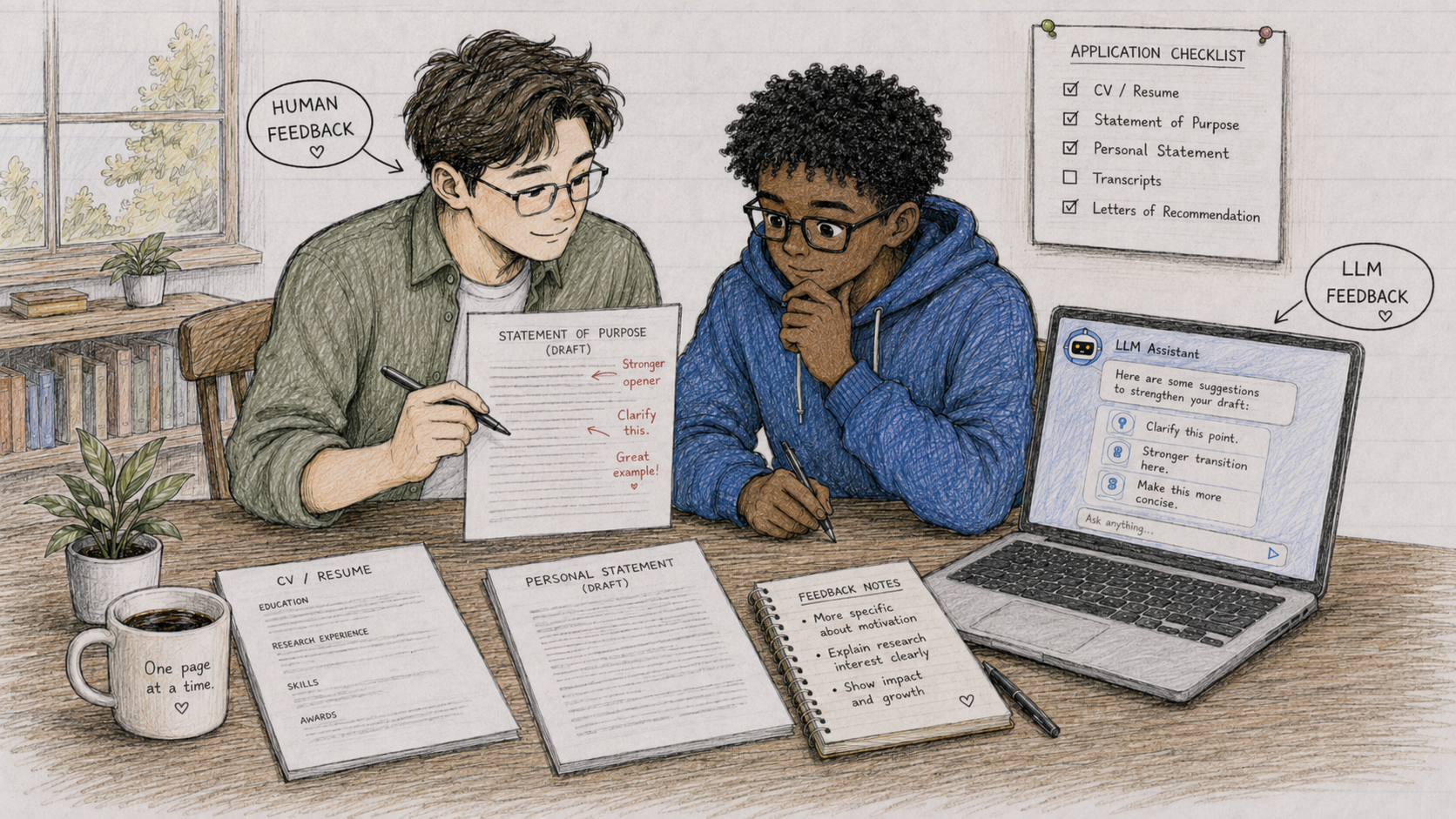
Ask people who have already gone through the graduate application process to review your résumé, CV, and statement of purpose. Seniors, professors, advisors, and previous applicants can often notice unclear sections that you may have missed after reading the same document far too many times. Ask more than one person, but not so many that you fall into an endless cycle of revising everything after every new comment. It can help to get feedback, update the document, and then ask someone to review the new version rather than collecting ten different opinions at once.
Remember that every reviewer brings their own preferences, and nobody understands your experiences as well as you do. Listen to the advice, but make the final judgment yourself. At the same time, take comments about clarity seriously. If an outside reader says that something feels vague, a professor or admissions committee member may feel the same way because they are also reading your story without all the context you have in your head. The goal is to find a balance between being open to feedback and keeping the application genuinely yours.
Applying to graduate school can get expensive very quickly. There is the TOEFL fee, the cost of sending score reports, university application fees, and possibly the GRE on top of all that. These costs add up faster than you expect. I received fee waivers from three or four universities simply by emailing the departments, so do not be afraid to ask. Some departments also offer waivers through graduate information sessions, especially during the summer and early fall. Attend these sessions when possible and ask early, since waiver budgets may be limited. A short and polite email, or one well-timed information session, can save you a significant amount of money.
For master’s funding, you usually have two main pathways, teaching assistantships and research assistantships. Ph.D. programs are often funded, but funding for master’s students can be less straightforward. For TA positions, email the department, check when applications open, and apply as early as possible. For RA positions, reach out directly to professors whose work aligns with your interests. From what I have observed, RA positions for master’s students are usually harder to secure than TA positions, but they are still worth exploring.
Once you submit your applications, try not to fall into the rabbit hole of constantly checking Reddit and websites where people post their application status. I did exactly that, as if refreshing the page often enough might somehow influence the admissions committee. Whatever happens, remember that you gave the process your best. As someone who was unsuccessful in two application cycles before finally getting in on the third, trust me when I say this. Be kind to yourself and to the people around you. The waiting can be stressful, and stress can make all of us a little impatient or irritable.
If you receive a Ph.D. interview, take it seriously and prepare thoroughly. Professors will often care more about whether you deeply understand your own research than whether you have memorized every paper they have written. Be ready to explain the problem you studied, why it mattered, the decisions you made, what failed, how you evaluated the work, and what you would do differently. Research skills are often transferable across topics, and explaining your reasoning clearly can matter more than having worked on the exact same problem as the professor.
Once you receive offers, compare the full financial and practical picture before making a decision. Consider tuition, living costs, available funding, visa requirements and timelines, and possible backup plans. An admission offer may be exciting, but the program must also be financially and practically realistic.
One of my advisors said something to me that has stayed with me. When you look back years from now, even a two-year wait to get into graduate school will feel like a very small part of a much longer life. And even if it does not happen, that outcome will not define who you are or what you are capable of. Work hard, give it your all, and be kind to yourself and others along the way. Good luck, and I hope everyone applying finds their way to the place they have been dreaming of.