Loss is one of those experiences in life that almost everyone understands because we have all felt it in some form, whether small or life-changing. It can arrive suddenly through a phone call, a hospital room, a breakup, or a move to another country. Or it can arrive quietly, when a friend or a sibling becomes distant, a familiar place no longer feels like home, or a future you once imagined with someone slowly becomes impossible. In simple terms, loss is what happens when someone or something that matters to us is no longer available in the same way.
The Psychology of Loss
Psychologists talk about loss in different ways. One useful distinction is between tangible and intangible loss. Tangible losses are easier to see from the outside, such as death, breakup, divorce, bankruptcy, or losing a home. Intangible losses are harder to see, but just as real. They include the loss of trust, safety, identity, belonging, emotional stability, or a future we once imagined. Another important idea is ambiguous loss, a way of describing losses that are unclear or unresolved. It can happen when someone is physically absent but psychologically present, such as after disappearance, migration, estrangement, or ghosting. It can also happen when someone is physically present but psychologically absent, such as with dementia, addiction, severe illness, or emotional unavailability.
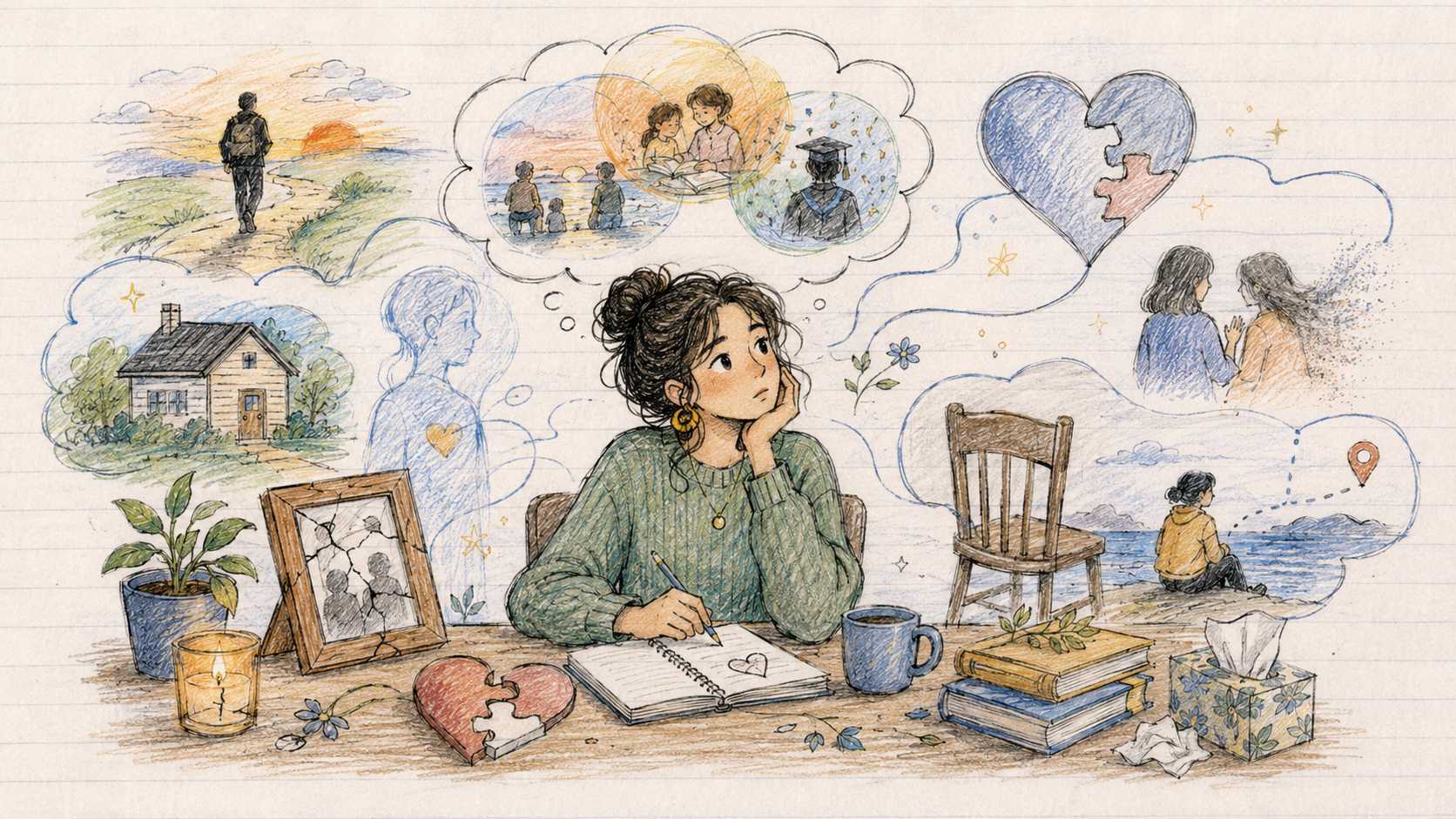
Loss hurts because of attachment, and grief is what follows when that attachment is broken, changed, or made uncertain. The people close to us are not just background characters in our story. Over time, they become part of how we feel safe, how we understand ourselves, and how we move through the world. A parent can feel like home. A sibling can hold a whole childhood. A friend can become part of our everyday rhythm. And a partner can become someone we quietly build the future around.
For me, this is where loss becomes strangely interesting. Even when we know something has changed, our mind does not always catch up immediately. We may still expect the message, the call, the familiar voice, the old routine, or the version of life that used to make sense. The facts may be clear, but the brain has learned a version of the world in which that person, place, or future still has a role.
I find myself returning to this question often. Why are we built like this? If we know that something has changed, if we know that someone is gone, distant, or no longer available in the same way, why can’t the mind simply grieve for a while and then return to normal? Why do we linger? Why do we keep reaching toward what is no longer there, even when doing so brings more grief?
At first, this seems almost irrational. Absence should be simple. Someone was here, and now they are not. Something was possible, and now it is not. But then I wonder whether this messiness is also the point. As Gino D’Acampo once said, “If my grandmother had wheels, she would have been a bike.” In the same spirit, if I could process loss without the strange train of emotions, the ups and downs, the remembering and re-remembering, then maybe I would not be very human at all. Maybe I would just be an LLM with no chest pain, no terrible urge to revisit old memories, no consciousness, no longing, just next-token-predicting my way through life.
The Neuroscience of Loss
This is where neuroscience begins to answer the question. Maybe the mind does not simply grieve for a while and return to normal because loss is not just an emotional event. It is also a learning problem. The brain has learned a version of the world in which someone, somewhere, or some future still had a place. When that changes, the brain cannot instantly delete the old model and install a new one like a window's software update, which is honestly very inconvenient of it. Instead, it has to slowly relearn what the world is like now.
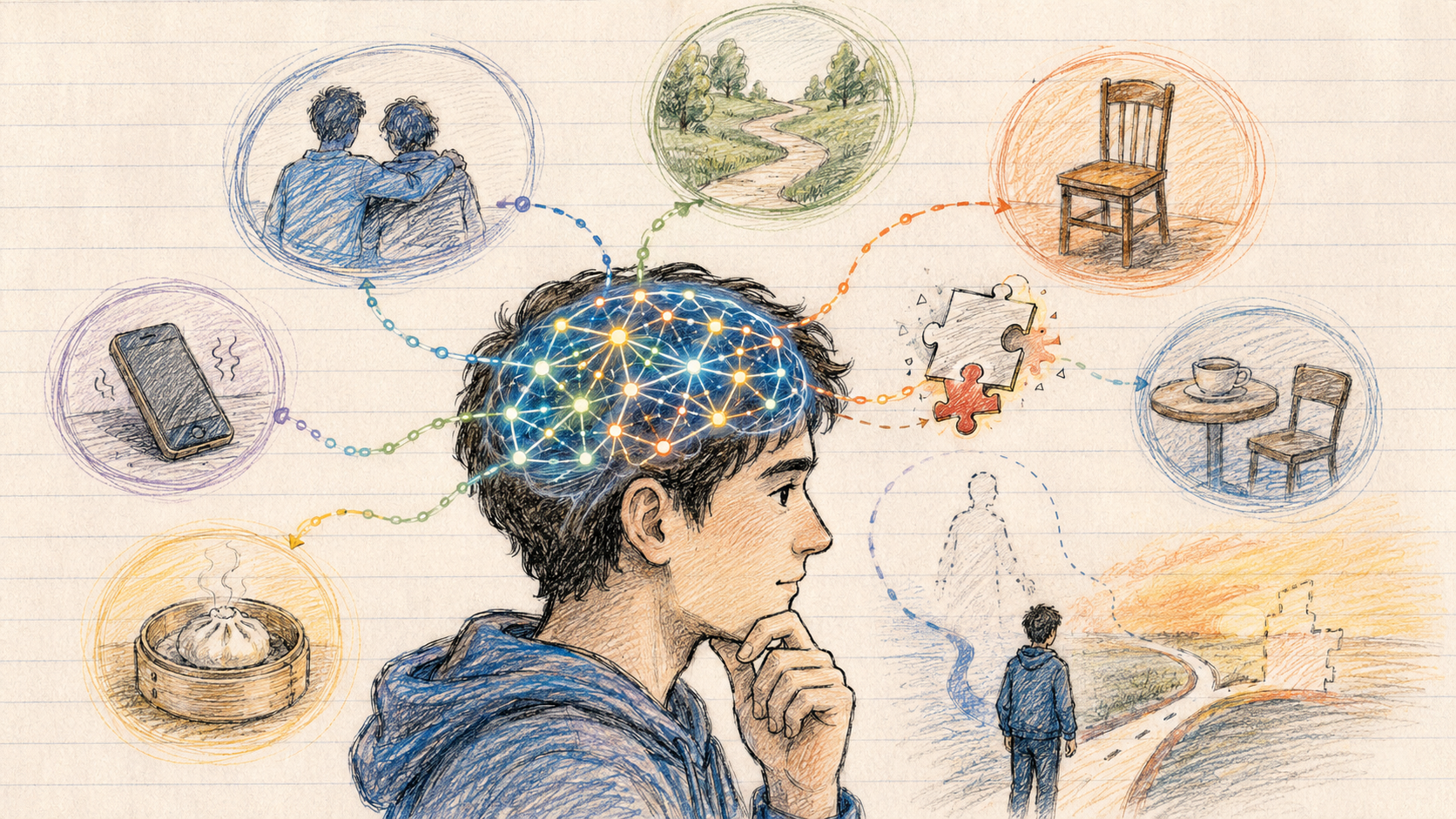
When someone has been part of our life for a long time, the brain does not treat them as random noise. It gives them weight. They become a high-probability part of our routines, our memories, our emotions, and our expectations. This is the person we call when something good happens. This is the voice we expect to hear in the house. This is the friend who replies to a certain joke. This is the parent who makes the world feel stable. This is the partner around whom the future was being built. So when that person is no longer available in the same way, the brain has to do something very difficult. It has to update a model of the world in which that person still has a very real place.
In neuroscience, this mismatch is often called a prediction error. The brain expects one thing, and the world gives it something else. Usually, this is how learning happens. You expect your keys to be on the table, they are not there, so your brain updates the model and checks your bag next time. But with loss, the prediction error is not about keys or weather or a misplaced phone. It is about someone who mattered. The mind reaches toward a familiar pattern, and reality does not complete it.
That is why absence can feel so specific. A café is not always just another café. It can become the café that still remembers a conversation, a laugh, or the version of life you were living then. A silent phone is not always just a silent phone. It can feel like the place where a message should have arrived. Even something as small as a dumpling is not always just a dumpling. It can carry the flavor of a life you once knew. The brain is not only noticing that something is missing. It is noticing that something that is expected did not happen.
I feel like even if neuroscience helps explain why the mind lingers, it does not fully answer what loss means. If the brain is simply updating an old model of the world, why does that update feel so personal? Why does the absence of one person change the meaning of a room, a song, a city, or even a future? Why does losing someone sometimes feel like losing a part of ourselves? At some point, loss stops being only a question of memory and prediction. It becomes a question of meaning.
The Philosophy of Loss
Philosophy enters here because loss is not only about what disappears. It is about what that disappearance does to the life that remains. If neuroscience tells us that the brain is updating an old model of the world, philosophy asks why that update feels so personal. Why does one absence change the meaning of a café, a food item, a song, or a future? Why does losing someone sometimes feel like losing a version of ourselves?
Maybe it is because the things we love do not stay outside us. They become part of the structure through which we understand life. A parent is not only a person. A parent can become origin, safety, memory, and home. A friend is not only a friend. A friend can become a witness to who we were at a certain time. A partner is not only a partner. A partner can become the person around whom the future begins arranging itself. So when loss happens, the pain is not only that someone is gone. The pain is that a whole structure of meaning has shifted.
At this point, loss stops being only a question of memory and prediction. It becomes a question of meaning. And this is where Kafka and Dostoevsky feel useful to place beside each other, because they seem to understand pain in very different ways. Kafka shows how loss can become an inner room we cannot easily leave. Dostoevsky asks what kind of person we become after entering that room. One shows the wound of unreachable love. The other asks whether the wound will make us less loving or more human.
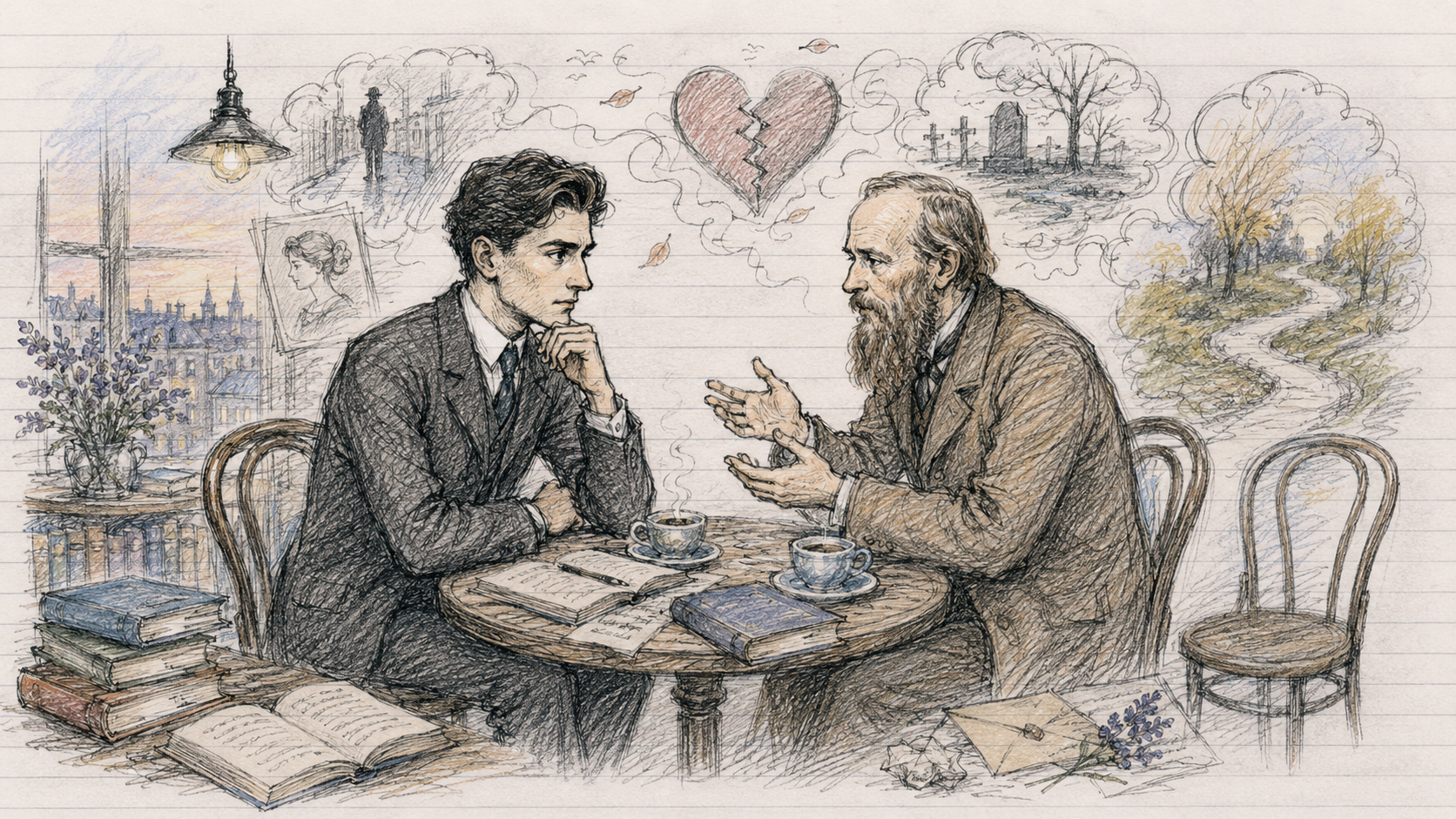
Kafka shows that absence is not always empty. In Letters to Milena, the beloved is often far away, but not really gone. She exists in letters, imagination, waiting, fear, and longing. This is a strange kind of presence. The person is not physically there, but the mind keeps meeting them again and again. Kafka shows how loss can live inside thought itself, where someone absent can still feel painfully close. Dostoevsky looks at pain from another direction. Kafka shows how absence can stay trapped inside the self. Dostoevsky asks what suffering does to the self. In The Brothers Karamazov, grief is not only an emotional wound. It becomes a moral question. Does loss close us off, make us bitter, and shrink the world? Or can it deepen our ability to love, remember, and care?
Al-Ghazali adds another layer. For him, loss is not only psychological or moral. It is also spiritual. The things we love in this world are real, but they are not fully ours to keep. People change. Bodies weaken. Homes disappear. Relationships shift. Futures do not always arrive in the form we imagined. Loss reveals the temporary nature of the world, not to tell us that love is meaningless, but to remind us that love in this world always carries vulnerability inside it.
I think all of this does not mean that we should stop loving. If anything, maybe it means we should love more honestly, more openly, and with fewer assumptions that people will always know what they mean to us. If the world is temporary, as Al-Ghazali reminds us, then love should not always be kept hidden for later. If Kafka shows how painful unreachable love can become, then maybe we should try to reach the people we love while we still can. And if Dostoevsky asks what suffering does to the soul, then maybe the answer, at the end of loss, should still be kindness.
The Poetry of Loss
I believe poetry is the ultimate expression of human emotions because it allows us to say what ordinary language often cannot. Psychology can tell us why attachment turns into grief. Neuroscience can tell us why the brain keeps expecting someone who is no longer available in the same way. Philosophy can ask what absence does to meaning. But poetry does something else. It opens the gates for emotions to flow. It takes the ache, the memory, the longing, the anger, the tenderness, and all the strange little contradictions of loss, and lets them exist without immediately trying to fix them. It does not explain loss better than psychology, neuroscience, or philosophy. It simply allows loss to sound like itself.
This is why poetry feels so natural when we talk about loss. Loss is full of things that are hard to say directly. The empty chair. The song that suddenly changes meaning. The building that remembers too much. The message that never arrives. The future that still appears in the mind even after it has become impossible. Poetry gives language to these small, strange things without forcing them to become neat.
Urdu poetry especially understands this. It has a whole emotional vocabulary for separation, memory, longing, patience, betrayal, and disappearance. There is hijr, the state of separation. There is yaad, memory that keeps returning. There is gham, sorrow that does not remain only sorrow but becomes part of how a person sees the world. There is jafa, the wound of cruelty or betrayal, and sabr, not as a magical cure, but as the difficult act of continuing to live while carrying what has changed. And then, in the spiritual language of poetry, there is fanā, the dissolving of the self, and baqā, the sense that something still remains after that dissolving. Urdu poetry does not treat loss as one emotion. It treats it as a complex spectrum of feeling.
Maybe this is why Urdu poetry rarely treats healing as forgetting. Ghalib would remind us that the heart is not made of stone, so of course it fills with pain:
دل ہی تو ہے نہ سنگ و خشت، درد سے بھر نہ آئے کیوں
روئیں گے ہم ہزار بار، کوئی ہمیں ستائے کیوں
Dil hi to hai na sang-o-khisht, dard se bhar na aaye kyun
Royenge hum hazaar baar, koi humein sataye kyun
It is only a heart, not stone or brick. Why should it not fill with pain?
We will cry a thousand times, so why should anyone torment us for it?
But Faiz would take the next step. He would not deny personal grief, but he would gently turn our face back toward the world. Our pain is real, but it is not the only pain that exists. Maybe healing is not forgetting the wound. Maybe it is learning how to carry it without letting it become the whole world.
I think this is where I keep returning at the end. Loss should not teach us to feel less. If anything, it should remind us to express more of what makes us human while we still have the chance. To love openly. To say the kind thing. To send the message. To sit with people while they are still here. To not assume that people know how much they matter to us just because we feel it strongly inside. Love can become absence, absence can become loss, and loss can become grief. But grief does not have to make us colder. Maybe, if we let it, grief can make us more honest with our emotions, more gentle with other people’s pain, and more willing to show love before it has to become memory.