When I was about to start my Ph.D., I read Muhammad Khalifa’s blog, Eight Lessons Learned in Two Years of Ph.D., and at that moment, I decided that I would pause and reflect when my first year ended. I am only one year into this journey, so I do not want to pretend that I have figured it all out. I definitely have not. But I do think the first year teaches you a lot about research, about pressure, about people, and most importantly, about yourself.
This blog is my attempt to reflect on my first year of Ph.D., the mistakes I made, the moments I enjoyed, the things that overwhelmed me, and the small lessons that kept me going. I want to talk about the difficult parts honestly, but I want to place them between the good ones so that the blog begins with a hopeful and positive flavor, moves through the messy parts, and ends with a sense of quiet optimism.
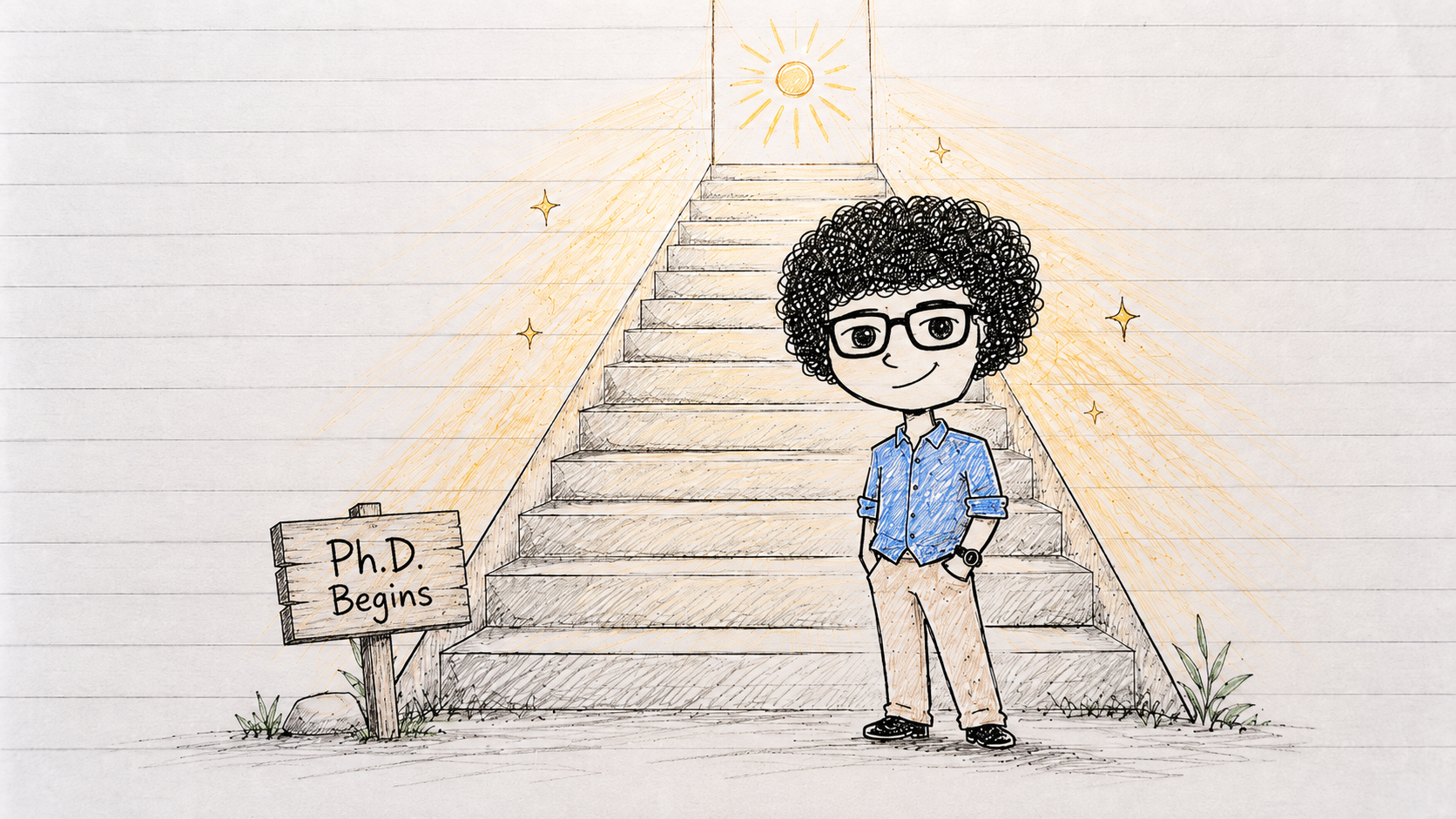
1. The Beauty of Beginning
Being in a Ph.D. program, especially as an international student, is not just about research. It is also about arriving in a new place, learning a new rhythm of life, meeting people from different backgrounds, and slowly finding a sense of belonging. I feel lucky to have supportive people around me, my advisor, seniors, lab mates, and friends. A good research environment does not make the hard days disappear, but it makes them survivable. And sometimes, in the middle of deadlines and stress, walking around campus with calm music in your ears, hearing people’s stories, and realizing that you are surrounded by people working so hard to grow as researchers reminds you that this itself is something beautiful.
2. Research Interests Take Time to Develop
One thing I realized very early is that research interests are not always obvious from the beginning, and that is completely okay. In my first meeting, I said I wanted to work on AI agents. In the next one, it changed to cultural alignment. Then it became AI safety, and now, while I am still interested in AI safety, I also want to explore theoretical machine learning. You may start a project thinking, “This sounds interesting,” and after spending weeks or months on it, realize, “Okay, this is interesting, but maybe not something I want to do in the long run.” And that is okay. The first year is not only about producing results; it is also about discovering what kinds of questions you enjoy asking. Even after my first year, I am still a little conflicted, but maybe that is part of the process.
3. The Pressure of Being in a Fast-Moving Field
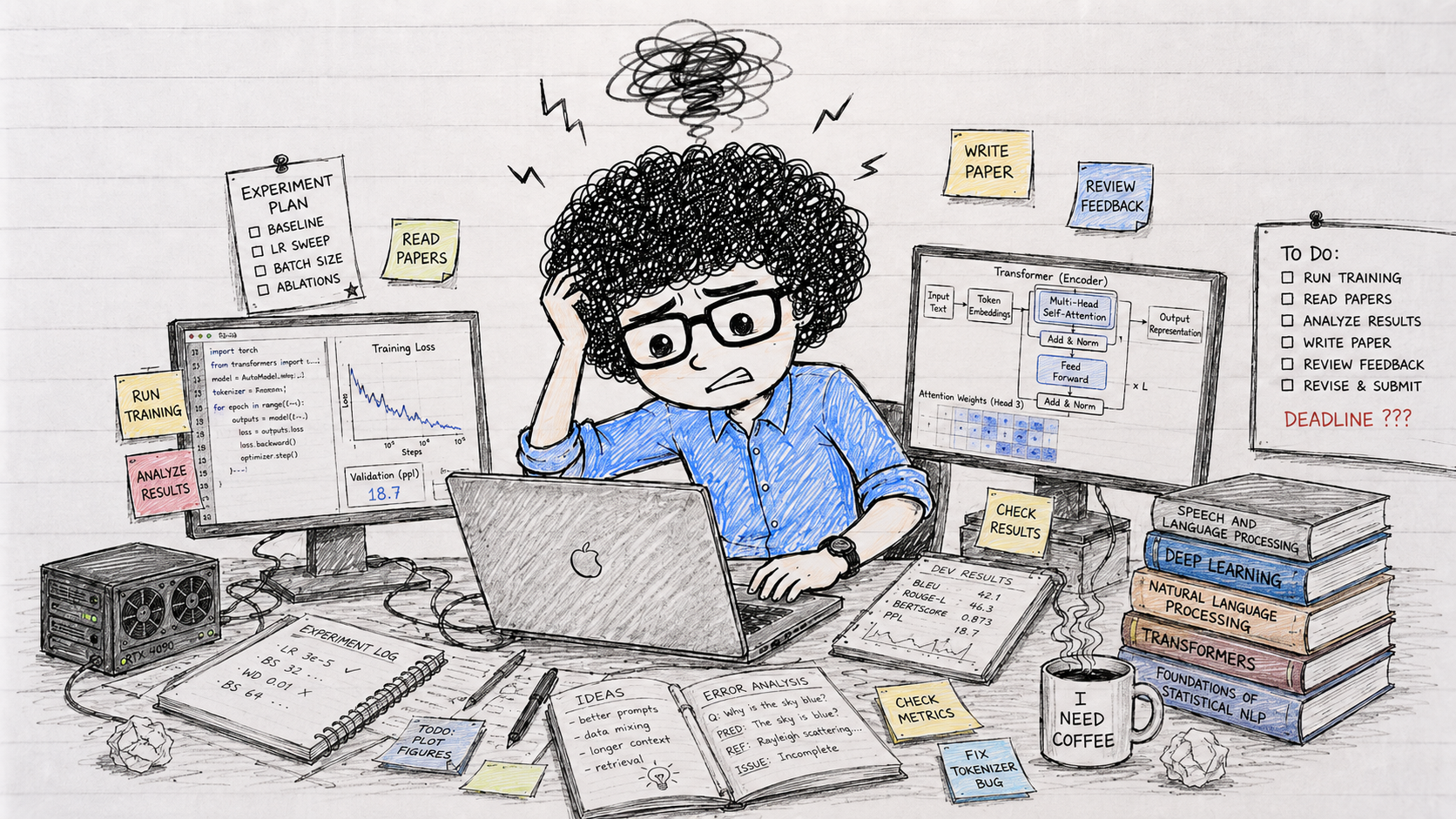
AI and NLP are moving at an incredibly fast pace. There is always a new paper, a new model, a new benchmark, a new framework, and a new deadline. It is easy to feel that if you are not submitting something to the next conference, you are falling behind. That fear of being left out can quietly burn you out. Sometimes, the pressure is not only about whether your work is good; it becomes about whether you have something visible, something accepted, something to show. When reviewers think your paper is not novel or strong enough, it hurts. But what hurt me more was the feeling that I had missed a chance to “keep up.” I think I have started making peace with this, though I may only know for sure when the next review cycle comes around.
Recently, I got into plants. I got a jasmine and a lemon plant, so I will use this as an analogy: a Ph.D. feels more like learning to care for something that grows slowly. You water it, give it light, wait patiently, and still, some days, nothing seems to change. But quietly, something is taking root. Maybe becoming a researcher is partly about learning to accept failure, sit with it for a while, and then move forward anyway.
4. Research in the Age of AI Feels Different
Doing research in the age of AI, I don’t know, it just feels strange. On one hand, AI tools make life easier. You can use Claude, GPT, Cursor, or other AI agents to write code, debug experiments, generate diagrams, summarize papers, and improve writing. Ideas that would previously take much longer to prototype can now be tested much faster. But that also creates a new kind of pressure. Because things are easier, you feel like you should be doing more. If an AI agent can help implement one idea while you think about the next one, then why stop? I guess this is where convenience becomes a little dangerous. AI reduces friction, but it can also quietly increase expectations.
AI is everywhere now, in writing papers, making figures, coding experiments, and sometimes even generating entire papers. Researchers may use AI to help with writing. Reviewers may use AI to phrase their reviews. Even when AI is not forming the scientific judgment itself, there is still a constant suspicion in everyone’s mind. Was this written by AI? Was this reviewed by AI? Is any of this still fully human? I don’t know, sometimes this made me question my own research. If AI is doing so much, why am I doing a Ph.D.? Should I have chosen something else, maybe Physics? I do not really have an answer to this yet. It is one of those questions that still plays in my mind, and I am still trying to figure out what to do with it.
5. The Messy Middle of Research
Another thing I learned is that research projects often look terrible before they look good. At the beginning, a project may feel completely scattered. You may go deeper and deeper into a rabbit hole. Experiments may fail. Results may be confusing. The story may not be clear. You may wonder whether there is even a paper here. But sometimes, after enough reading, experimenting, and rewriting, the story starts to appear. The pieces slowly connect. What once felt messy begins to flow naturally. Of course, this does not always happen. Sometimes a project fails, and that is part of the process too. Not every idea becomes a paper. Not every experiment gives a publishable result. But even failed projects teach you something and make the next idea a little clearer.
6. The Mistake of Doing Too Much
One mistake I made was working on too many projects at the same time, even when everyone told me not to do more than two at once. Keeping track of everything becomes mentally exhausting. You are constantly switching contexts (you are not an LLM) while trying to remember different experiments, deadlines, collaborators, and writing tasks. It becomes stressful and messy. The funny part is that I know this, I have learned this, and yet I still keep making the same mistake. I even made it again a few days ago. Maybe the exact number is different for different people, but the principle is the same. Focus matters. Mental clarity matters.
7. Read, Test, Iterate
In a fast-moving field, reading can feel impossible because there is always more. But reading is what builds your taste. It helps you understand what has been tried, what matters, and what questions are worth asking. AI tools can help with reading, summarizing, and navigating the literature, but they should not replace your own judgment. Also, do not be afraid to test ambitious ideas. Sometimes an idea sounds too strange or too ambitious, but the only way to know is to try. I tested one such idea recently related to 1.58-bit LLMs. It did not work. And that is fine. Tomorrow I can either iterate on it or test something else. That is just how research works.
8. The Small Rewards Matter
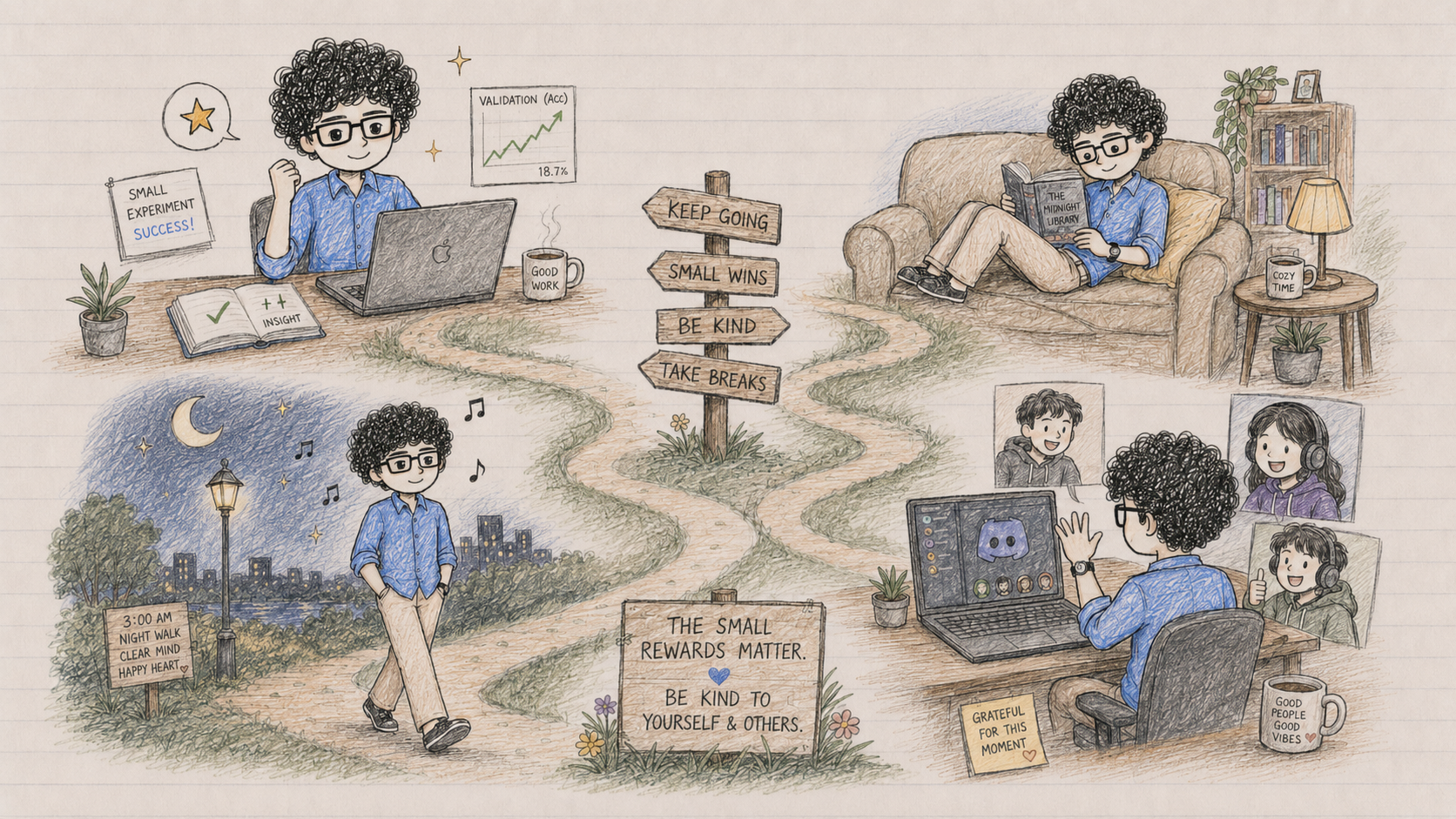
Despite all the stress, there are moments that make the whole process worth it. A small experiment finally runs successfully, a metric improves, a graph starts to tell a story, or the abstract finally explains the idea clearly. These moments may seem small from the outside, but they can feel incredibly rewarding when you have spent weeks or months struggling. I think you enjoy the reward more when you learn to enjoy the process. The Ph.D. has big milestones, but most of daily research is made of small steps. Learning to appreciate those small steps keeps you going.
9. Be Kind to Yourself and Others
There were moments when I felt like giving up. There were moments when I overworked myself. There were moments when I felt behind, confused, or unsure whether I was doing enough. I know for sure that there will be such moments in the future too. But I also realized that when things do not go your way, kindness matters even more. Be kind to the people around you. Be kind to your collaborators. Be kind to your friends. And especially, be kind to yourself. Take breaks. Play games and talk to your friends on Discord at the end of the week. Go outside at 3 AM for a walk and listen to the music you like. Sit on your sofa in a weird, back-breaking position and read a book. Let yourself be a person outside of research. These things are not distractions from the Ph.D., sometimes, they are what make the Ph.D. sustainable.
در این خاک در این خاک در این مزرعه پاک
بجز مهر بجز عشق دگر تخم نکاریم
Dar in khak dar in khak dar in mezra’e pak
Bejoz mehr bejoz eshq degar toxm nakarim
In this earth, in this earth, in this pure farm
Let us sow nothing but the seeds of kindness and love
If I had to summarize my first year, I would say this. Stay curious, stay consistent, and stay kind. Research will keep changing, papers will come and go, experiments will fail and succeed, and there will always be moments of doubt. But I hope I can carry these three things with me into my second year of Ph.D. I want to keep asking better questions, keep showing up even when progress feels slow, and keep being gentle with myself and the people around me. Maybe that is how something meaningful slowly grows.